List of types of penguins We will introduce their characteristics and ecology. Penguins are one of the most popular animals in the world. There are currently 18 types of penguins living in the world, and many people keep them in captivity. Here we will introduce a list of the types of penguins there.


- Basic Information about Penguins
- About the History of Penguins
- Penguin Conservation Status and Endangered Species
- Interesting penguin facts
- About Penguin Molting
- Penguin Diving Ability
- 🧠 Reasons why they are good at diving (evolutionary adaptations)
- Penguin Calls
- A Penguin’s Daily Life
- Introducing the types of penguins
- コウテイペンギン(Emperor Penguin)
- キングペンギン(King Penguin)
- アデリーペンギン(Adelie Penguin)
- ジェンツーペンギン(Gentoo Penguin)
- ヒゲペンギン(Chinstrap Penguin)
- ガラパゴスペンギン(Galapagos Penguin)
- ケープペンギン(African Penguin)
- フンボルトペンギン(Humboldt Penguin)
- マゼランペンギン(Magellanic Penguin)
- フィヨルドランドペンギン(Fiordland penguin)
- シュレーターペンギン(Erect-Crested Penguin)
- スネアーズペンギン(Snares Islands Penguin)
- マカロニペンギン(Macaroni Penguin)
- ロイヤルペンギン(Royal Penguin)
- イワトビペンギン(Rockhopper Penguin)
- キンメペンギン(Yellow-Eyed Penguin)
- コガタペンギン(Little Penguin)
- ハネジロペンギン(White-flippered Penguin)
- Can penguins be kept?
- Summary
Basic Information about Penguins
Let’s start with some basic information about penguins. Penguins are flightless birds that live in the cold regions of Antarctica and the Southern Hemisphere, and are better adapted to life in the water than on land. Key points are summarized below.
Classification
Kingdom Animalia > Phylum Chordata > Class Aves > Order Sphenisciformes
A type of bird belonging to the family Spheniscidae.
Currently, approximately 18-20 species are known.
Habitat
Distributed primarily in the Southern Hemisphere.
Found in a wide range of habitats, from polar regions around Antarctica to warm regions such as South America (Chile, Argentina), Australia, New Zealand, and the southern tip of Africa.
Some species (such as the Galapagos penguin) live near the equator.
Physical Characteristics
Body Type: Short legs, streamlined body, highly waterproof feathers.
Feathers: Hard, waterproof-like surface. Their dense undercoat keeps them warm.
Flightless but skilled swimmers: Their wings are not adapted for flight but for propulsion in the water.
Thermoregulation: Their thick layer of fat helps them maintain body temperature even in cold climates.
Diet
They primarily feed on marine organisms such as fish, squid, and krill.
They catch their prey by swimming at high speeds underwater.
Reproduction
Nests vary by species, from rock formations to holes or even on ice.
Many species are monogamous, with parents taking turns incubating the eggs.
They usually lay one to two eggs, which take about one to two months to hatch.
Sociality
Many species live in colonies where they live together.
Natural predators include killer whales and seals, and on land, they are influenced by certain birds and human activity.
About the History of Penguins
The “history” of penguins encompasses both their biological evolution and their relationship with humans. Let’s organize them in order.
Evolutionary and Biological History
Origin
Penguins are thought to have appeared approximately 60 million years ago (after the Paleogene and Late Cretaceous periods).
Their ancestors were flightless birds, but they eventually lost flight and specialized in swimming to adapt to aquatic life.
Fossil Record
The oldest penguin fossils have been found in New Zealand and South America.
Ancient penguins were larger than modern penguins, with some species reaching heights of 1.5-2 meters.
They diversified over time, with small- to medium-sized species becoming the norm today.
Adaptation
Wings evolved for swimming, not flight (“flipperization”).
Their streamlined body shape, thick blubber, and dense feathers allowed them to adapt to cold climates.
Flock breeding and cooperative behavior also developed during the course of evolution.
History with Humans
Ancient to Early Modern Times
Penguins existed around Antarctica before humans arrived.
Indigenous peoples (such as Maori) used them as food along the coast of South America and in New Zealand.
Modern Times
In the 18th and 19th centuries, European explorers observed and recorded penguins while exploring Antarctica and the Southern Hemisphere.
During the Imperial Era, penguins were sometimes over-hunted for feathers and oil.
Modern Times
With growing awareness of ecosystem conservation, efforts are underway to protect endangered species.
Penguins have become a global target for tourism and research.
As their habitat changes due to climate change and fishing, ecological research is becoming more active.

Penguin Conservation Status and Endangered Species
Penguin habitats and populations vary greatly depending on the species, and many species are currently protected. A detailed summary is provided below.
Penguin Conservation Status
Major Threats
Climate Change
Ice loss and rising sea temperatures are changing the distribution of fish and krill, which serve as prey.
This has a particularly significant impact on species that breed on the ice of the Antarctic and sub-Antarctic.
Competition with Fisheries
Commercial fishing, which harvests large amounts of prey (fish and krill), is causing food shortages.
Natural Enemies and Invasive Species
Terrestrial-breeding species are affected by introduced predators such as cats, rats, and dogs.
Human Activities and Environmental Pollution
Impacts of oil spills and plastic waste.
Destruction of breeding habitats due to tourism and base construction.
Threatened Species and Classification
Major Classifications by the IUCN (International Union for Conservation of Nature)
Endangered (EN)
Galapagos Penguin: Population of approximately 10,000 or less, declining due to climate change and human activity.
Macaroni Penguin: Large population, but showing a significant decline.
Vulnerable (VU)
Humboldt Penguin: Impacted by fishing and invasive species along the coast of South America.
King Penguin: Declining in some areas due to climate change.
Least Concern (LC)
Adelie Penguin, Chinstrap Penguin, Emperor Penguin (however, Emperor Penguin is at risk in the future due to climate change).
Conservation Efforts
Breeding Ground Protection
Breeding grounds are protected in nature reserves in Antarctica, South America, and New Zealand.
Fisheries Management
Fishing limits and marine protected areas are established to protect penguin food resources.
Invasive species control
Eradication and management of rats, cats, and other insects.
Climate change countermeasures
Evaluation of future impacts through international research and monitoring.
Education and tourism management
Tourism guidelines and awareness-raising activities that do not destroy ecosystems.
Interesting penguin facts
Penguins are not just adorable, but their ecology and behavior are very unique. Here are some interesting facts.
They’re flightless birds, but they’re master swimmers.
Penguins’ wings, called “flippers,” are specialized for propulsion in the water.
Some species can swim at speeds of over 36 km/h.
They can also change direction extremely quickly in the water, making them ideal for catching fish and krill.
They can withstand extreme cold on the ice.
Their thick layer of fat and dense feathers allow them to maintain body heat even in the sub-zero temperatures of Antarctica.
Emperor penguins breed on the ice during the Antarctic winter, with parents taking turns incubating their eggs.
Cooperation within a Flock
During the breeding season, colonies can number in the thousands or tens of thousands.
To protect themselves from the cold, they huddle together.
Collective behavior also enhances safety when traveling and hunting.
Mate Loyalty
Many species are monogamous, reproducing with the same partner year after year.
Parents take turns caring for eggs and raising chicks, working together to raise them.
Individual Identification Ability
Parents and offspring or pairs can be identified by their calls and body patterns.
Parents and chicks can find each other even in the noisy midden of a large colony.
Surprising Size Variation
The smallest penguin, the little penguin, is approximately 33 cm long.
The largest, the emperor penguin, is approximately 1.2 m long and weighs 30-40 kg.
The size difference is nearly four times as large.
They Live in Some Surprising Places on Earth
Penguins live not only in Antarctica, but also in the Galapagos penguins near the equator.
It’s surprising to learn that some species can live on sandy beaches and in warm waters.

About Penguin Molting
Molting is a physiological process in penguins where old feathers fall out and new ones grow in their place. It’s a crucial and stressful event for penguins’ survival.
Basic Mechanism of Molting
Penguins live in saltwater, so the waterproofing and heat retention of their feathers are essential. During molting:
Old feathers fall out all at once.
New feathers are rapidly produced beneath the skin.
During this time, the “waterproofing” properties of the feathers temporarily decrease.
Therefore, most penguins can barely swim during molting.
① There are periods when they cannot eat.
This is especially important, as many species cannot enter the sea during molting:
They fast for several weeks to over a month.
They endure by using body fat.
② Their appearance becomes ragged.
Their feathers fall out in patches.
They become fluffy and downy.
They appear weak at first glance.
③ They expend a lot of energy.
They use a large amount of energy to create new feathers:
They may lose a significant amount of weight.
They need to rest.
“Catastrophe Molt”
A particularly famous example is the type seen in emperor penguins, where
Their feathers fall out almost simultaneously.
During this time, they completely fast on land.
This is a very high-risk survival strategy.
Penguin Diving Ability
Penguins are “birds that have specialized in the sea instead of flying,” and their diving abilities are among the best of all birds. While there are differences depending on the species, they have all evolved as “underwater hunters.”
Penguins possess the following abilities:
Underwater Speed: 6-10 km/h (over 20 km/h for short distances)
Diving Time: Several minutes to over 20 minutes (depending on the species)
Purpose: Primarily for catching fish, squid, and krill
Underwater, they swim by using their wings to fly rather than simply flapping them.
🥇 Emperor Penguin (Top Class)
Emperor Penguin
Diving Depth: Over 500m (Record: approximately 565m)
Diving Time: Over 20 minutes
Dives to beneath the ice in the frigid Antarctic
👉 Nearly “mammal-level diving ability” for a bird
🐧 King Penguin
King Penguin
Diving Depth: Approximately 100-300m
Diving Time: Approximately 5-8 minutes
A stable deep-diving type
🐧 Adélie Penguin
Adélie Penguin
Diving Depth: Around 150m
Diving Time: 2-6 minutes
A type that chases small fish at high speed
🧠 Reasons why they are good at diving (evolutionary adaptations)
① Heavy bones (difficult to float)
→ Easily sinks in water, advantageous for diving
② Wings are “paddle-like”
→ Not wings for flying, but underwater propulsion devices
③ Efficient oxygen management
Stores a lot of oxygen in muscles
Significantly reduces heart rate to conserve oxygen
④ Insulation from body fat + feathers
→ Can maintain body temperature even in extremely cold seas

Penguin Calls
Penguin calls are actually quite diverse and noisy forms of communication, rather than simply “cute” sounds. They vary greatly depending on the species and situation.
① Colony “Noise”
Hundreds to tens of thousands of penguins call out simultaneously.
A mixture of sounds like “Gyaaa,” “Kaaa,” and “Oink-Oink.”
From a distance, it sounds like a “mass of noise.”
👉 In fact, penguin colonies are quite noisy.
② Parent-Child Calls (Most Important)
Emperor penguins are particularly famous for this:
Parents: “A low, growling sound”
Chicks: “A high, shrill sound”
👉 Amazingly, parents can distinguish their own chicks’ voices from tens of thousands of other birds.
③ Courtship Calls
Gentoo penguins, in particular, are famous for this:
Males call out to females while presenting them with stones.
“A trumpet-like sound,” “An ‘Oink’ sound”
Quite unique and romantic (by penguin standards).
④ Warning/Threatening Sounds
Short, strong calls
Makes these sounds with the beak wide open
Used against intruders or during conflicts.
A Penguin’s Daily Life
A penguin’s daily life follows a fairly regular and efficient rhythm, alternating between foraging in the sea and living in groups on land. While there are slight variations depending on the species and season, the basic flow is consistent.
🌅 Morning: Start of Colony Activities
Wake up with the group (colony)
Preen their feathers (grooming)
Warm themselves up and confirm each other’s presence through calls
👉 Feather preening is crucial for maintaining waterproofing
🌊 Morning to Afternoon: Foraging (Main Activity)
This is the center of the day for emperor penguins and other species.
Jumping into the sea and beginning their dive
Foraging for fish, squid, and krill
Repeating several to dozens of dives
Characteristics:
Dive duration: Several minutes to about 20 minutes
Foraging distance: May travel several kilometers to tens of kilometers
🏖️ Evening: Returning to land and resting
Returning to the flock to rest
Huddling together to maintain body temperature (especially in cold regions)
If there are chicks, feeding them (regurgitating food to feed them)
💤 Night: Rest and warmth
Resting almost completely motionless
Huddling together in groups in strong winds and cold
More of an “energy-saving state” than actual sleep
Introducing the types of penguins
The introduction is quite long, but I would like to introduce modern penguins. There are 18 species of penguins in 6 genera, all of which are designated as endangered species. If you knew everything, you would be Dr. Penguin. I will summarize them in a table and present them in a list. You can see that there are many different types in New Zealand.
| Name | genus name | habitat area |
| コウテイペンギン(Emperor Penguin) | Aptenodytes コウテイペンギン属 | 南極大陸 |
| キングペンギン(King Penguin) | Aptenodytes コウテイペンギン属 | 南大西洋、インド洋 |
| アデリーペンギン(Adelie Penguin) | Pygoscelis アデリーペンギン属 | 南極大陸 |
| ジェンツーペンギン(Gentoo Penguin) | Pygoscelis アデリーペンギン属 | 南極大陸 |
| ヒゲペンギン(Chinstrap Penguin) | Pygoscelis アデリーペンギン属 | 南極大陸 |
| ガラパゴスペンギン(Galapagos Penguin) | Spheniscus フンボルトペンギン属 | ガラパゴス諸島 |
| ケープペンギン(African Penguin) | Spheniscus フンボルトペンギン属 | 南アフリカ |
| フンボルトペンギン(Humboldt Penguin) | Spheniscus フンボルトペンギン属 | チリ |
| マゼランペンギン(Magellanic Penguin) | Spheniscus フンボルトペンギン属 | 南アメリカ太平洋岸 |
| フィヨルドランドペンギン(Fiordland penguin) | Eudyptes マカロニペンギン属 | ニュージーランド |
| シュレーターペンギン(Erect-Crested Penguin) | Eudyptes マカロニペンギン属 | ニュージーランド |
| スネアーズペンギン(Snares Islands Penguin) | Eudyptes マカロニペンギン属 | ニュージーランド |
| マカロニペンギン(Macaroni Penguin) | Eudyptes マカロニペンギン属 | 南極大陸 |
| ロイヤルペンギン(Royal Penguin) | Eudyptes マカロニペンギン属 | 南極大陸 |
| イワトビペンギン(Rockhopper Penguin) | Eudyptes マカロニペンギン属 | 南大西洋、インド洋、フォークランド諸島 |
| キンメペンギン(Yellow-Eyed Penguin) | Megadyptes キンメペンギン属 | ニュージーランド |
| コガタペンギン(Little Penguin) | Eudyptula コガタペンギン属 | ニュージーランド、オーストラリア |
| ハネジロペンギン(White-flippered Penguin) | Eudyptula コガタペンギン属 | ニュージーランド |
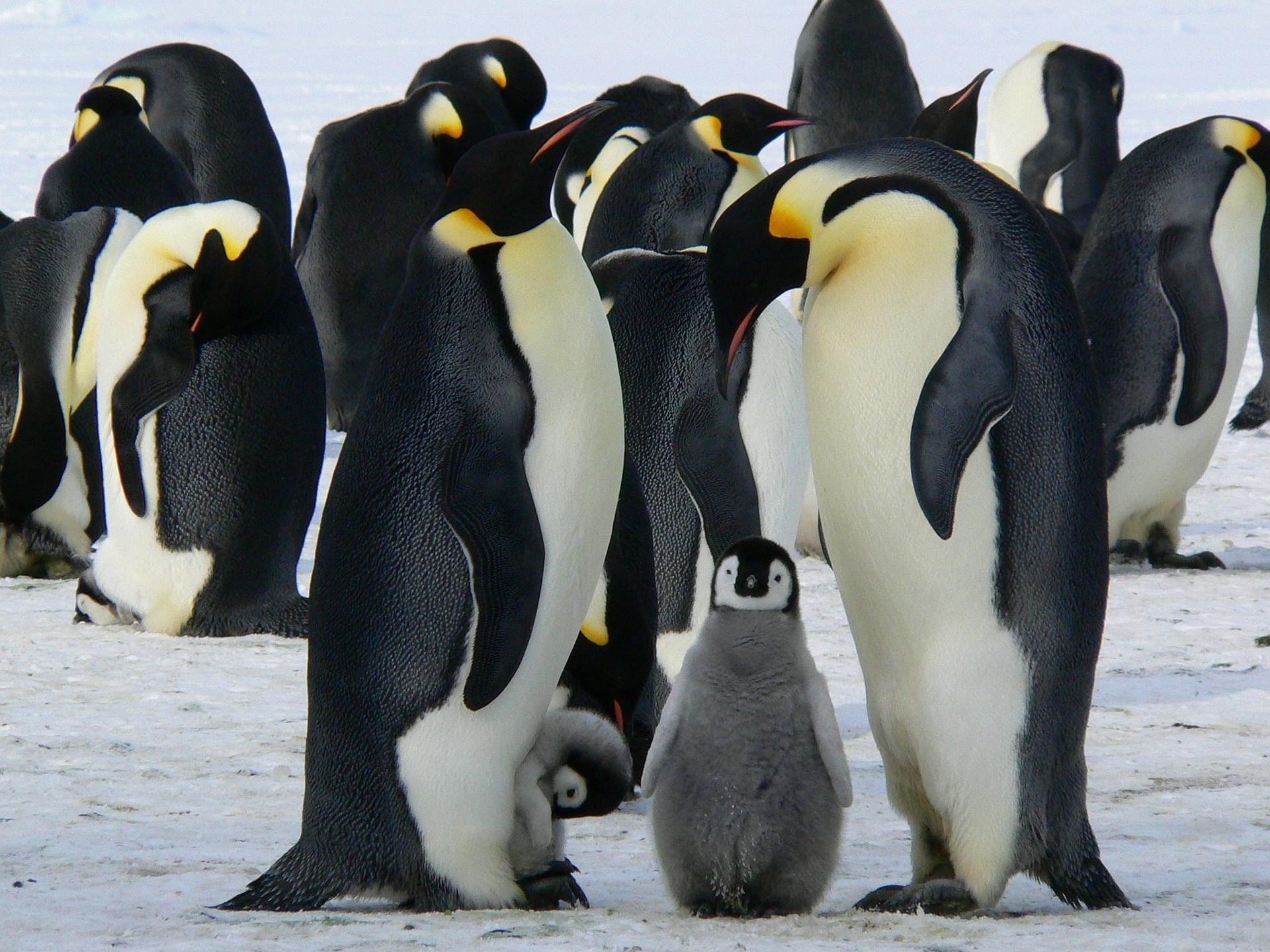
コウテイペンギン(Emperor Penguin)
The emperor penguin is the largest penguin and is also called the emperor penguin. It is adapted to the harshest environment on earth, Antarctica. They are 100cm to 130cm long and live in Antarctica, eating squid and krill. It is the largest and most robust of all penguin species.

キングペンギン(King Penguin)
King Penguin is also called King Penguin. The second largest penguin, with a body length of 85cm to 95cm, it forms colonies (breeding grounds) on Kerguelen Island, Crozet Islands, Prince Edward Islands, Marion Island, Heard Island, and Macolini Island in the relatively warm subantarctic region. make a living. King penguins live in colonies and nearby beaches.
アデリーペンギン(Adelie Penguin)
Adelie Penguin should be familiar to Japanese people. This is because it is the motif of JR’s Suica. It has a distinctive white eye ring around its eyes and a two-tone black and white color scheme, and is found mainly in Antarctica.
ジェンツーペンギン(Gentoo Penguin)
Gentoo Penguins live around Antarctica. Eyes are brown. It is characterized by a white eye ring that resembles a bear. Gentoo penguins have excellent diving ability, with an average diving time of 2.5 minutes and an average diving depth of 80 m.
ヒゲペンギン(Chinstrap Penguin)
Chinstrap Penguin is a type of penguin that is characterized by a whisker-like pattern under its chin. It is 70-76cm long and lives in Antarctica. The body is dark blue and the cheeks are white.
ガラパゴスペンギン(Galapagos Penguin)
Galapagos Penguin is a penguin that lives only in the Galapagos Islands. It is very small, with a body length of 50 cm and a weight of only 2 kg. Galapagos penguins are rare among penguins and live in tropical regions just below the equator. It is characterized by a thin white line from the eyes to the chin and a black band around the chest.
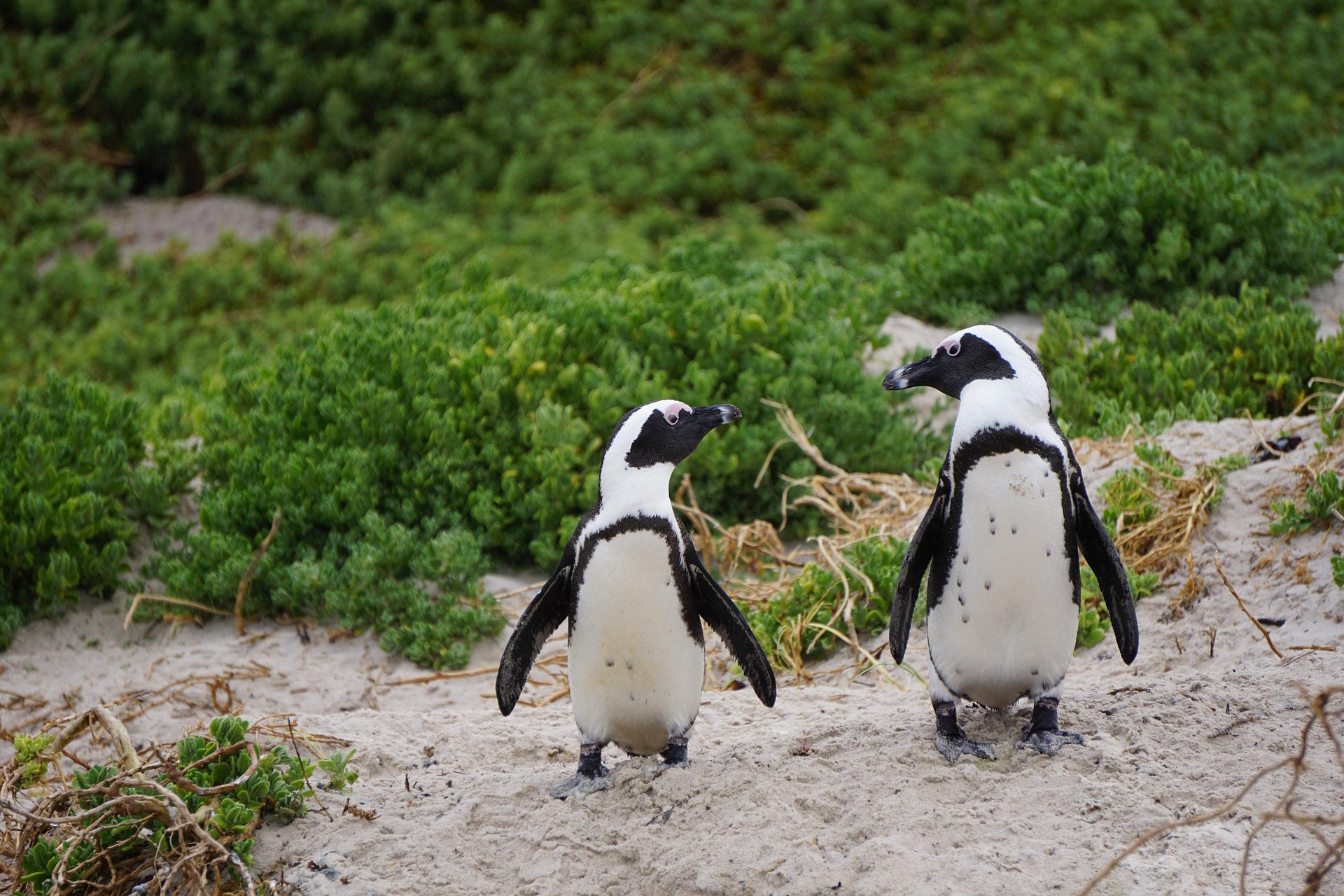
ケープペンギン(African Penguin)
The African Penguin is Africa’s only penguin, living in South Africa. This penguin lives in relatively warm areas and can live with humans. This medium-sized penguin is distinctive for its pink eyes and black legs. You often see it in illustrated books and reports.
フンボルトペンギン(Humboldt Penguin)
The Humboldt Penguin is a penguin that lives in western South America, where the Humboldt Current flows. They are characterized by a thin white line on their head and a thick black line between their neck and chest, and because they live in relatively warm areas, they can be said to be easy to live with humans.
マゼランペンギン(Magellanic Penguin)
The Magellanic Penguin is said to be the penguin discovered by Magellan, the navigator who circumnavigated the world. It is a medium-sized penguin with a body length of about 65 to 70 cm. Unlike other Humboldt penguins, it has two black lines on its chest.
フィヨルドランドペンギン(Fiordland penguin)
Fiordland penguin A penguin with a crest that can only be found in the fjords, Auckland Islands, and Stewart Island. The crest is similar to that of a snares penguin, but there is a white line on the cheek.
シュレーターペンギン(Erect-Crested Penguin)
The Erect-Crested Penguin is a penguin that lives in the Bounty Islands, Auckland Islands, Macquarie Island, etc. It is a penguin with a body length of 65 to 70 cm and a very distinctive yellow crown feather.
スネアーズペンギン(Snares Islands Penguin)
The Snares Islands Penguin is a penguin that can only be seen on Snares Island. Their body length is 51 to 61 cm, and Snares Island itself is an island that only researchers can visit, so the general public cannot even touch it.
マカロニペンギン(Macaroni Penguin)
The Macaroni Penguin is a medium-sized penguin that lives in the southern part of Chile, from the Atlantic Ocean to the Indian Ocean. Its most distinctive feature is the yellow crown that grows from the middle of its forehead. Macaroni refers to the style of macaroni that was popular in modern England.
ロイヤルペンギン(Royal Penguin)
The Royal Penguin is a penguin that lives on Macquarie Island, Australia and New Zealand, and unlike the macaroni penguin, it has a white face. Also, the body is slightly larger than the macaroni penguin, so it is a different species.
イワトビペンギン(Rockhopper Penguin)
The Rockhopper Penguin has not only yellow crest feathers, but also black crest feathers. There are subspecies, such as the eastern rockhopper penguin and the southern rockhopper penguin. It moves in a special way by jumping from rock to rock.
キンメペンギン(Yellow-Eyed Penguin)
The Yellow-Eyed Penguin is also called the Yellow-Eyed Penguin. It lives in New Zealand, and its main characteristic is that it has a bright yellow head.
コガタペンギン(Little Penguin)
Little Penguin, also known as Fairy Penguin or Blue Penguin, is the most popular penguin in the world. They are very cute as they are only 30cm long. Little penguins can be found in Australia and New Zealand.
ハネジロペンギン(White-flippered Penguin)
The White-flippered Penguin is a subspecies of the Little Penguin. The difference is that the edges of the wings are white and the white-bellied penguin is slightly larger. They are also very small penguins, only about 40cm long. It can only be seen on Banks Peninsula and Motonau Island.

Can penguins be kept?
Penguins are adorable, but because they require a specialized environment, they are extremely difficult to keep in the average household. They are usually kept only in zoos and aquariums. Here’s some basic information about keeping them:
Environment
Water and Land
Aquarium: The tank must be large enough and deep enough for them to swim.
Land: Provide sand and rocks for resting and breeding.
Temperature Control:
Antarctic penguins (e.g., emperor penguins and Adelie penguins) require cold water and ice.
Penguins from temperate regions (e.g., Humboldt penguins) can be kept in slightly warmer water temperatures.
Water Quality Control
Water temperature, salinity, and purity must be maintained.
Aquariums are kept clean with a filtration system.
Diet
Their staple diet consists of fish (sardines, herring, mackerel, etc.), krill, and squid.
In captivity, they should be fed two to three times a day.
Supplementing with vitamins and supplements to ensure a balanced diet is also important.
Breeding Management
During the breeding season, provide sand, rocks, and nesting holes.
Observe and support mating compatibility and breeding behavior.
Professional knowledge is required for managing eggs and chicks.
Health Management
Regular health checks are required (weight, feathers, and digestive system checks).
Careful attention is needed for infectious diseases and parasites.
Penguins are sensitive to stress, and an inappropriate housing environment can lead to loss of appetite and illness.
Legal and Ethical Issues
Many penguins are subject to the Convention on International Trade in Endangered Species of Wild Fauna and Flora (CITES), and private import and breeding are often restricted by law.
Even in Japan, as a general rule, they are only kept in facilities with special permits, such as zoos and aquariums.
Summary
Penguins are extremely delicate, and careful management of their swimming environment, water temperature, and diet is essential.
Keeping them in an average household is virtually impossible.
It is safest for animals to be kept in specialized facilities under the supervision of zookeepers with specialized knowledge.
コメント